

Q: Simon, you’ve had quite a personal and professional journey over the past years, from journalism, writing on New Monasticism, doctoral research at Hull, and into urban ministry. You continue writing and are Chair of Trustees for the Progressive Christianity Network, in Britain (PCN). How has your understanding and practice of your faith changed through this time?
A: It can be hard, I think, to distinguish between ‘what I think now’ and ‘what I used to think.’ Sometimes I find myself using that awful phrase ‘I’ve always thought…’ which is, of course, an untruth. Every experience changes us; the way we see the world alters from moment to moment. So, of course, my ‘understanding and practise of faith’ has changed over time. I grew up in a low-key conservative evangelical Baptist church, where piety was important, as was social justice — but what it meant to ‘have faith’ had a lot to do with assent to traditional doctrines. I began to ‘put away childish things’ in my teens, but found it challenging to know what to replace them with.
One thing that has long been important to me is the issue of suffering. The human experience of suffering, the alleviation of suffering, the suffering of the world, and the suffering of the divine all jostle for space inside my mind. Partly, I think this has to do with my own experience of suffering, particularly the death, at birth, of our third child. It is this experience, beyond any other, which I would point to as my most profound spiritual or religious awakening. I believe it changed me more than anything else.
There’s something about that sort of experience that exposes the poverty of the doctrines that are routinely expounded in many churches — and there’s something about the near universality of that sort of experience that means we have to take seriously the challenge of leaving behind inherited and unquestioned assumptions.
I’ve moved, I suppose, from a place of apparently secure but ultimately very flimsy child-like certainty, through a comforting cloud of adolescent uncertainty, to some new place where I find things change with a certain amount of fluidity. I have, somehow, become comfortable with discomfort.
As well as being a writer and chair of PCN (which is a very part-time, voluntary role), I am also a minister in the United Reformed Church. When I trained for ministry, I found my fellow ordinands were at times perplexed by my position. “This is Simon, he doesn’t believe in God,” one said when introducing me to a friend. “That’s not quite right,” I said, “I just think the phrase is pointless unless we share a clear understanding of what it means to ‘believe’ and what we mean by ‘God’.”
Faith, I think of as ‘faithfulness’ – I think that’s a better translation of the Greek anyway, it’s less to do with cognitive assent to an idea, more to do with loyalty. I think I can say that my loyalty has remained more or less the same, even if my idea of who, or what, I am loyal to, has changed substantially over time.
Q: Have there been any particular transforming experiences or religious/theological insights that have affected you personally? If so, what are these, and how did they affect you?
A: Yes, as I said, the death of my son was one such experience — it was, and is, a profound influence on me. It made me, I think, more compassionate, less judgmental, more inclined to love and forgive — when you stop to think about it, that was a profound gift he gave me. But there have been others too — and in some ways it’s difficult to differentiate between the importance of different experiences. A (sometimes more regular than others) practise of meditation has been hugely influential for me, and intentionally engaging with people who hold radically different views to me has also been very important. Friendship with people of other faith traditions — such as my dear, late friend Marcus — helped shape me at a deep level.
For my doctoral project, I had the opportunity to spend significant time working on and with process philosophy and theology — and this has really shaped my thinking. Understanding the world as a series of interlinked processes — recognising that everything is in constant change, or that change is itself the only true constant — is powerful.
One of the first writers I found who spoke to me where I was ‘at’ was Brian McLaren, I read some of his early work in my early twenties, and I remember saying to my wife; ‘other people think like us!’ McLaren was, perhaps, a gateway drug for me, and I went on to the hard stuff. But others were also important in those early days. Actually, I think the Baptist minister and social entrepreneur Steve Chalke could be said to have radicalised me as a teenager. His commitment to ‘faith-fuelled’ social change connected with me in an important way — I was pleased to have had the opportunity to spend several years working with Steve’s charity, The Oasis Trust, in my thirties and early forties.
It sounds pretentious, perhaps, especially from someone like me who has spent most of their life living on Northern council estates, but I think Alfred North Whitehead was right to say that all of Western philosophy is a ‘series of footnotes to Plato’ — I’ve spent more time reading the words of long-dead Greeks than is probably healthy. Oh — and Zen. That’s taught me a lot, or perhaps I should say continues to teach me a lot, or maybe it has taught me nothing, because Christianity is not the only place where paradox is to be found.
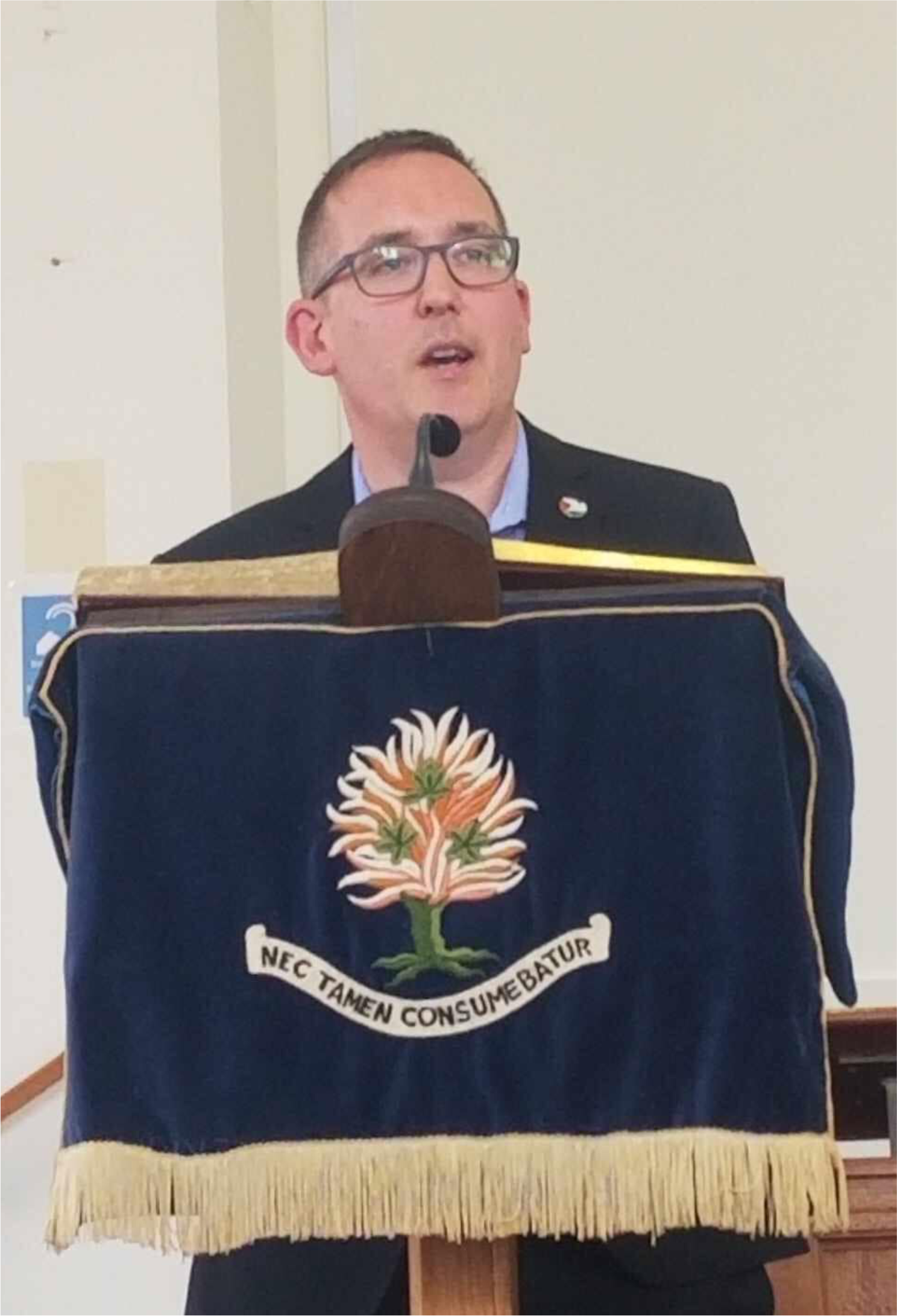
Q: Thinking about how you live your faith, can you say how your outlook influences or impacts your life today (your life with Kelly, your life in church, in the local community, and so on)? What meaning does it have for you in practice?
A: I can honestly say, I think, that my faith – my ongoing attempts to be faithful to the ways of Jesus, that paradoxical path of enemy love, repeated forgiveness and resilient hope in the face of enormously powerful forces — has a very clear and ongoing impact on my life. For better or for worse, we’ve chosen a path which differs from many of our contemporaries. As many of them now seem to be cruising towards early retirement, I find that my work feels as though it’s hardly started. Sometimes I sense in myself some level of regret for that — mostly though I think we’ve made good choices.
A deep, and I hope genuine, sense of solidarity with the ‘wretched of the earth’ as Frantz Fanon might have put it continues to motivate me at a deep level. A sense, too, that everything is interconnected, that nothing exists in a vacuum, but that life itself is a series of interconnected processes, means that I try to see the world through that lens. My sense is that everything and everyone is to be respected and treated as worthy of care and love. Do I manage to translate that into consistent decision-making? Honestly — no. But I continue to try.
Love continues to be my goal and my guide — although that sounds horribly pretentious, and saying it causes me to doubt myself somewhat. Perhaps I should say that ‘when I’m at my best, love continues to inspire me, and to lead me.’
At the end of last year, I was in a meeting with my local MP, listening to a lot of leaders from other religious and cultural traditions. They spoke, inevitably, about how intimidating they found the St George’s flags that had been hoisted around parts of our city. I understood what they meant, and it left me reflecting on the motivation for this apparent show of ‘patriotism’. “I think it’s a lack of hope,” I said. “People feel like they don’t have hope.” My sense, or perhaps my hope, is that Christianity has hope to offer to everyone, if only we can communicate it clearly.
Q: You’ve said that the way of Jesus is an intensely political path. Will you unpack what this political vision means to you, and perhaps, as you see it, for your church and for society?
A: From my perspective, Jesus only really makes sense through a political lens — a lens which understands the background of Jewish messianic expectation and the liberative struggle of his time. This is what I believe, this is what I teach — and this is what I write.
Now I know, of course, that we all seek to remake Jesus in ‘our own image’ and I dare say I’m as guilty of that as anyone. I simply can’t see that any alternative vision of the life of Jesus is coherent, though, except by way of magical thinking. And I’m no great fan of magical thinking. Among the writers who articulate this political sense of who, and what, Jesus was most clearly, to my eyes, is John Dominic Crossan. I would certainly say that what little we can say about the life of Jesus would have to take into account, or perhaps begin with, the political struggles of the time. When Jesus came down to the sea of Galilee, the nexus of Herod Antipas’ taxation economy, he began to form communities of resistance — an alternative economy — an alternative ‘kingdom’ in the heart of the empire.
I think that Christianity, at its best, is still expressed through communities of resistance. Our rituals, our poetry, our prayers – these are all powerful tools to support and renew us in that resistance – but when stripped of their meaning, they can become meaningless, nice perhaps, but meaningless.
I think it’s true to say that Christianity must always be a minority pursuit. It should always be a prophetic irritant. It is and will always remain vulnerable. Where the church has taken power, over the years, it has ably demonstrated why it should not.
In contemporary political terms, I would describe myself as an anarchist — but, like all labels, it’s a bit too reductive and certainly isn’t one I think could be appropriately applied to Jesus. I’m an anarchist primarily because I don’t ultimately believe in the concept of the nation state — certainly not as the location of ‘legitimate violence’ as Weber defined it. I do believe, however, that we should act as Jesus did, which means we should proactively develop communities of resistance where the upside-down values of enemy love and compassion can be nurtured. This, I think, is what we can, and should, call ‘God’s work.’
Simon’s Website — simonjcross.com
Progressive Christianity Network — http://www.pcnbritain.org.uk