

CC BY-SA 4.0, Wikimedia

PD, Wikimedia

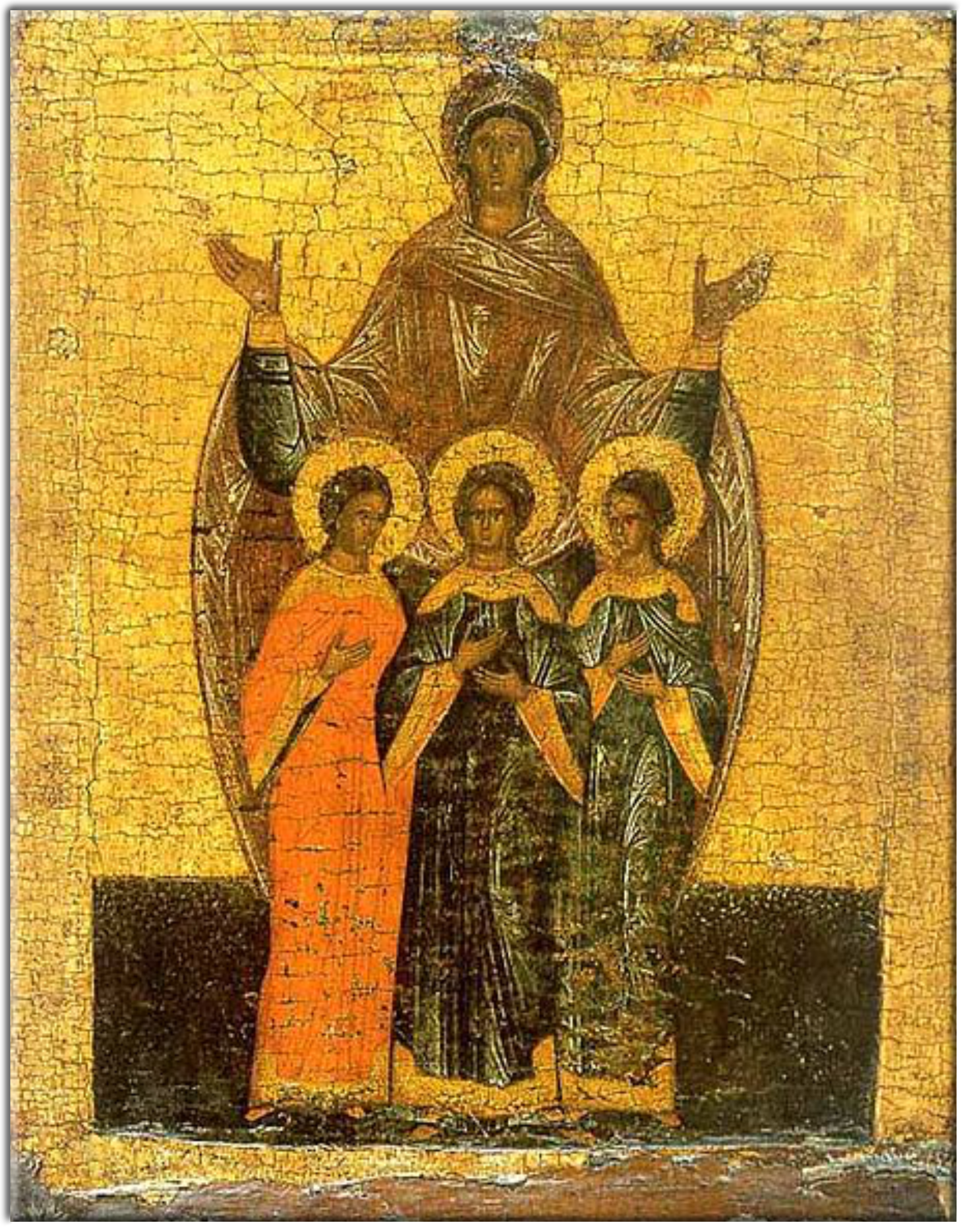
The widow Sophia and her daughters, Faith Hope, and Love, are said to have lived in the first or second century and to have been martyred in Rome in one of the Christian persecutions, perhaps in the time of emperor Hadrian, 117–138 ce.
They were venerated from the sixth century and the number of statues and icons show the popularity of their cult. Their feast day is widely observed among Orthodox Churches, where it is celebrated on 17 September.
An Orthodox Kontakion (a liturgical hymn on the theme of the day), acclaiming these daughters, alludes to I Corinthians 1. 20–27. The Pauline verse refers to the Greeks seeking wisdom (sophistry), but God choosing the weak to confound the mighty. It reads:
The holy branches of noble Sophia,
Faith, Hope, and Love,
confounded Greek sophistry through Grace.
They struggled and won the victory
and have been granted an incorruptible crown by Christ the Master of all.
The Roman Martyrology once commemorated Faith, Hope and Love on 1 August and their mother Sophia on 30 September. However, the Catholic Church has since removed these saints as there is no historical evidence for their existence, although in Germany Sophientag is still celebrated, on 15 May.
But what are we to make of such a devotional cult today, given the lack of historical evidence for the existence of these saints? The French professor of hagiography, Victor Saxer,1 suggested that these saints are likely to have been personifications of the theological virtues of I Corinthians 13. 13. This reflects Don Cupitt's view that ‘Gods personify religious values’.2
In the 'wisdom literature' of the Hebrew Bible — Proverbs, Ecclesiastes, and Job — God is identified with wisdom (Khokhmah in Hebrew or Sophia in Greek). Churches dedicated to God as Wisdom include Hagia Sophia in Istanbul, and the church in the Capital City of Sofia in Bulgaria, after which the city was named. To hold Faith Hope and Love as St Sophia's daughters, depicts these virtues as coming from God. And like the 'Son of God', these martyred daughters of Wisdom were seen to have given their lives in witnessing to the character of God.
The hagiographic legend of Sofia, Faith, Hope, and Love give us personifications of spiritual ideals — with faith, hope, and love portrayed as the offspring of wisdom.
1 Victor Saxer, ‘Sophia v. Rom’, Lexikon für Theologie und Kirche (vol. 9) Edited by Michael Buchberger (Verlag Herder, 2000) p. 717. [https://archive.org/details/Lexikon-fur-Theologie-und-Kirche/Lexikon-fur-Theologie-und-Kirche-LThK3---Band-1%2C-eds.--Michael-Buchberger%2C-Walter-Kasper%2C1993/page/n30/mode/thumb Accessed 17 Dec. 2025]
2 Don Cupitt, Reforming Christianity (Polebridge Press, 2001) p. 117.